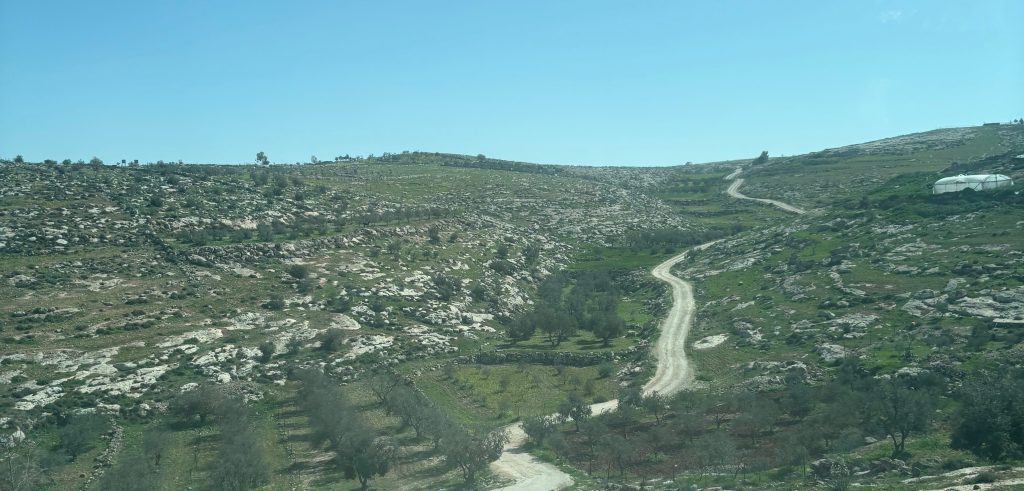
A Sermon for the First Sunday in Lent
Matthew 4:1-11
1Then Jesus was led up by the Spirit into the wilderness to be tempted by the devil.2He fasted forty days and forty nights, and afterwards he was famished.3The tempter came and said to him, “If you are the Son of God, command these stones to become loaves of bread.”4But he answered, “It is written,
‘One does not live by bread alone,
but by every word that comes from the mouth of God.’”5Then the devil took him to the holy city and placed him on the pinnacle of the temple, 6saying to him, “If you are the Son of God, throw yourself down; for it is written,
‘He will command his angels concerning you,’
and ‘On their hands they will bear you up,
so that you will not dash your foot against a stone.’”
7Jesus said to him, “Again it is written, ‘Do not put the Lord your God to the test.’”8Again, the devil took him to a very high mountain and showed him all the kingdoms of the world and their splendor; 9and he said to him, “All these I will give you, if you will fall down and worship me.” 10Jesus said to him, “Away with you, Satan! for it is written, ‘Worship the Lord your God, and serve only him.’” 11Then the devil left him, and suddenly angels came and waited on him.
Earlier in our service today, before we heard the word of God, or Pauls’ letter to the Romans, before the children’s sermon and the choral anthem, we paused, and together we confessed our sins. Corporately.
Why do we do that? Why does it matter that we take time, publicly, in worship, to name the mistakes we have made? And why do we use one prayer, that all of us say together, as the vehicle for confession?
You know, a few years ago, that confession got me in a little trouble with someone here at Trinity. Mostly because, in the particular prayer, on that particular day, I made explicit the notion that sin is not just something we do by ourselves. Sin, or “missing the mark,” as the word in the Greek roughly translates, is what happens when we—as a community, as a church, and as a society—participate, either through our actions, or just as importantly, by our inactions, in structural injustices. There are harms that we perpetuate by virtue of being connected to systems and powers and principalities that thrive at the expense of God’s Justice. That are sustained by our silence.
That is why we pray together, when we pray our confession. It is mean to remind us that we rise, but we also fall, together.
That, I think, is what Paul is driving at in our selection from his letter to the Romans, when he writes that death “has spread to all because all have sinned.” In that moment, he isn’t talking about lying to your spouse, or stealing candy from the grocery store. He is talking about something bigger. Communal injustice. The wrongs that we do together, often without even realizing it.
And according to Paul, the only way out, the only path beyond our tendency to perpetuate harm in the world, is through Jesus. Through the free gift of grace in Christ.
But what does that look like? What does it mean for us to accept that gift?
I think we get an idea in our scripture reading from Matthew 4. In Matthew 4, we are given a glimpse into the temptations that Christ faced at the beginning of his earthy ministry, and we are invited to meditate on what those temptations have to teach us, and how they play out even today, even in this moment, in the land of Christ’s birth, and in our own land.
Earlier this week I was on a bible study with Lamma Mansour, a Palestinian Christian living in Nazareth, and she had this to say about this text. She said “this temptation happens right after the launch of Jesus’ ministry. Instead of riding the wave to his advantage, immediately he steps into the wilderness, into a time of testing. But this is not meant to be a spiritual “how to,” or an individualized guide about resisting temptation. This is about what kind of messiah Jesus will be, and the difference between empire and kingdom.”
These temptations ask us to consider the question: what will the beloved kingdom of God look like? Will it look like spectacle? Will it look like superiority and power over? Or will it look like an incarnation, wholly embraced?
Because make no mistake: in the wilderness, the incarnation of Christ is intensified. And what the devil offers Jesus, over and over again, is the invitation to escape it. To escape the limitations of a body that is hungry, and that can be cast down, or lifted up.
So let’s look at those temptations, shall we?
The devil begins by requiring proof. Remember, Jesus has just been baptized in the river Jordan. The voice of God thundered from the heavens, shouting “this is my beloved son, listen to him.” And yet, the devil requires more proof. “If you are the Son of God,” he says, command these stones to be bread. He knows that Jesus is hungry, and weak. The temptation to eat is understandable. “If you are God’s son, why allow yourself to be limited by physical limitations?” And we know, of course, that Jesus can do it. Later on, he will offer bread as if by magic to thousands. So this notion is not out of the question.
But if Jesus does this, then he rejects his vulnerability. If he feeds himself, he no longer stands with those who cannot. He no longer is in solidarity with the vulnerable hungry and thirsty in his midst, the people of the land who are famished, and who cry out for stones to become bread to no avail. We know these people—we see them in our midst. Neighbors, strangers, the famished people of Gaza and the West Bank, who cry out for something to eat.
When Jesus says no to the devil, he isn’t rejecting bread. He is instead refusing to use his power to insulate himself from suffering. He is refusing the spectacle of stones into bread, because Jesus knows that hunger is political—when you control resources, you control people. And Jesus is someone who will feed people, but not to control them. He will feed them to liberate them.
So the devil moves on, bringing Jesus to the top of the Temple. To the place where, scholars tell us, the trumpets would blow to announce important news. It was a place to grab attention, to capture eyes. To throw himself unharmed from the temple would be to show that Jesus was invulnerable, that he could not be broken by this world. And it would be a rejection of the very vulnerability that will be on display on the Cross.
Again, Christ refuses. He will not seize attention with the propaganda of an invulnerable Messiah. Instead, he will hold fast to the scandal of incarnation: of a God who is revealed amongst the poor, the vulnerable, the crucified.
One last time, the devil offers Christ a way out: showing him the kingdoms of the world, he offers Jesus the power of imperial seduction. This is possibly the easiest temptation of all to understand, because we see it play out every day in the politics of the world—the grasping for influence, for power, for dominion. The way in which those who lead us feel compelled to deny their humanity and any glimpse of vulnerability.
This is a temptation that targets the very trajectory of Jesus’ mission. Why walk the slow path of incarnational love when you can serve power, the devil whispers. But Jesus rejects him, for he is building a different kind of kingdom, one built on service and love.
All of these temptations are, at the end of the day, about the shape of Jesus’ power. Each one is a shortcut that Jesus ultimately rejects.
And we who follow him would do well to pay attention, because these temptations to escape vulnerability are very much alive in this moment too. The temptation to care only for ourselves, to insulate ourselves, to seek power for ourselves—these shortcuts reveal themselves in the shape of the world around us. But Jesus invites us to another way—his incarnation stretches out a hand as says, “you do not have to use your power to shield yourself from the suffering of others. You do not have to mirror the very systems that you are trying to transform.”
One of the hardest things that we will ever do as Christians, I think, is to choose to turn towards the suffering of the world. To choose incarnation, and vulnerability, and solidarity with the hungry, and the powerless, and the disenfranchised. Because everything in our society invites us to do the opposite. To look past our suffering brother or sister. To distance ourselves from the hurt of the world. But our power is found in our willingness to stand close, to see, to hear, to be with those who suffer. Our strength is in our solidarity with the children of God that we refuse to look away from.
There is so much that I am still processing about my trip to the West Bank, and my time with the Palestinians who live there. But the one thing that I heard, over and over again, from farmers whose olive trees had been burned for no reason, from grandfathers who have been jailed and made to suffer without any formal charges, from women struggling to survive on remote mountaintops and leaders of nonprofits working with refugees, is the invitation: “go home and tell our story. Do not look away from our suffering. Tell the world that we want to live. Tell them that we desire nothing more than to live in the land of our fathers, alongside our neighbors, in peace.”
My invitation to you, dear friends, here on the first Sunday of Lent, is this: choose incarnation. Take it seriously. God did not seek to escape vulnerability, so perhaps we ought not to seek to leave it behind, either. Let us inhabit vulnerability with courage this Lenten season, as we stand alongside our brothers and sisters who suffer, and imagine the Kingdom of God, together.
Amen.
 Deeper in me than I
Leave a comment